Friday, May 30, 2008

HIKIFUDA


A
hikifuda is a handbill used in the Edo era (1603-1867) to advertise shops and products. It is called a stone block printed handbill which is believed to be printed by a lithographic stone.

Shopkeepers had a large variety of borders to choose from - immensely popular were the 7 Lucky Gods, ancient symbols, auspicious creatures, images that conveyed Japan's new "internationalism", and of course beautiful women - and new variations of these feel-good themes were added every year.

Early hikifuda were executed by the laborious technique of woodblock cutting. This eventually gave way at the close of the century to lithography or combinations of Western techniques .

This hikifuda that comes from a kimono store, features a typical bijin (beautiful woman) who is applying dye on stretched fabric for kimono.

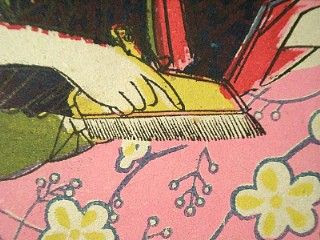


This brush called
jizomebake is used for
brushing large areas of dye quickly without streaks. The technique is called hikizome and is used for blending large areas of color.


A close-up of this
hikifuda shows craftsmen wringing fabric that has been dyed with indigo.


Another hikifuda also features indigo dyeing.


A close-up shows a dyer dipping fabric into indigo that has been stretched on shinshi.


Thank you to www.ichiroya for the images of the hikifuda

Sunday, May 18, 2008

OUT OF ALLIGNMENT

When weaving thread that has been ikat dyed there is much that is unpredictable. It comes from the fact that the threads have been pre-dyed. The warp and weft threads have to meet to form patterns. If they are out of allignment, here are some ways to make sure warp and weft patterns allign properly.

Friday, May 02, 2008

NISHIJIN ORI-KAIKAN

Hashigo is the term for the weaving apparatus, similar to a ladder, that is mounted on a loom. It is responsible for shifting the yarn for kasuri fabric. These photographs were taken at NISHIJIN ORI-KAIKAN in Kyoto, Japan

The history of Nishijin weaving go back some 1,200 years to the founding of Heian-kyo (the old name for Kyoto) the district managed the production of textiles for court nobles, and employed weavers to produce luxury fabrics. Today walking down some of the old streets you can still hear the beat and clack of looms. Kukuri is the name for this particular type of weaving.


The loom with the hashigo. The warp yarn is dyed in different colored stripes then shifted.


Details of the threading through the ladder.

Wednesday, April 16, 2008

E-KASURI OR PICTURE KASURI

This Japanese technique for weaving weft kasuri (ikat) enables very complex designs to be dyed and woven into the warp . The principle is a simple one that at first glance my seem complicated. It involves a seed thread (tane ito) or mother thread. This seed thread will be the one that will enable the weft to be woven into a design.

To make the seed thread, weave enough of the chosen weft thread to make one repeat of the pattern.

Draw a line down both selvedges in marker or ink. Then unweave the thread and roll it into a ball.


This is the drawing for e-kasuri.


Slip and tape the drawing inside a frame that has nails on either side. With the thread that has been unwoven from the loom go back and forth around the nails. Leave a few inches of thread at the beginning and end for adjusting the threads.

Trace the design onto the threads with a black marker or ink. Undo the threads from the frame by rolling it into a ball. This is the seed thread.


Examples of marked seed threads prior to weaving.


A stencil can also be used to mark the weft repeat.


The seed thread is stretched out or put on a warping reel. Then the weft thread is wound or placed alongside the seed thread, one thread for every repeat of the pattern. The resist ties will be wherever a dot or dash is marked on the weft thread.


Tying the resist threads where the
marks are.

*For tying instructions see the blog entry for Saturday, February 02, 2008


The weft marked and tied ready to be
dyed. After the thread is dyed the resists are untied, put on bobbins and ready to be woven.


This is the final result. The warp has been prepared with both blue and white warp threads. The weft pattern is broken in the center with plain white threads.

Tuesday, April 01, 2008

WARP SHIFTING DEVICES FOR KASURI


Indigo dyed Ikat from Equador


Mayan rebozo (shawl)


Thursday, March 20, 2008

WOODEN SHIFTING DEVICE


This is a simple way a shifting ladder can be constructed.
When warping the loom, the ladder can be mounted on the front or back of the loom depending on how the loom is dressed.


Monday, March 03, 2008

TWO SIMPLE SHIFT METHODS FOR KASURI

Tied warp ready to be dyed.
When untied the warp yarn will have bands of color, that when put on the loom and shifted will result in complicated patterns.


Thursday, February 14, 2008

NISHIJIN HIKIZURASHI KASURI

Nishijin hikizurashi kasuri is woven in the weaving district of Kyoto. The dyed warp is threaded through an unusual apparatus similar to a ladder (hashigo) that is mounted on the loom.

The warp is shifted by threading through the various levels of the ladder thus creating different patterns.


The yarn doesn't hav
e
to be elaborately
tied or dyed.


The shifting can result in many different patterns.

Saturday, February 02, 2008

KASURI OR IKAT INSTRUCTIONS: Various methods of tying warp

In the next blogs I will be showing information and instructions about the various forms of dyeing and shifting warp for kasuri / ikat.


Tying instructions


Tied yarn ready for dyeing.


Yarn that has been tied


Yarn that has been dyed and untied.


Possible patterns for shifting.

Saturday, January 19, 2008

KASURI

Kasuri (çµ£) is a Japanese textile technique that means splashed pattern. This technique can be done in the warp or weft or both. It is a style of plain weaving that uses a resist dyeing process similar to tie-dye. The threads are covered with paper, or plastic or any other material that will resist the dye. Thus the warp or weft threads are dyed in patterns or designs before the threads are woven. The completely white areas, the seismic, fuzzy edges of the design and the irregularities in the dyeing of the threads can identify this technique. Indigo dye is used for kasuri as well as other colors of dye. This weaving and dye technique is very labor intensive.

This type of fabric came from India to Indonesia, then by way of Okinawa and China to Japan. In India and Indonesia it is known as Ikat. Ikat means "to tie" or "to bind" in the Malay l
anguage and is the common term that identifies this technique.

There are four kinds of kasuri. Warp kasuri (tategasuri), weft kasuri, (yokogasuri), double kasuri (tateyokogasuri) where both the warp and the weft are tie-dyed before weaving and meet in precise patterns, and egasuri or picture kasuri where a picture such as a carp, flowers, fans, temples, tortoises or other auspicious images are tied and dyed into the warp.

Ikats have been woven in cultures all over the world. In Central and South America, the Central Asian country of Uzbekistan, South-East Asian countries of India, Indonesian islands of Bali and Kalimantan.

Like any craft or art form, ikats vary widely from country to country and region to region. Designs may have symbolic of ritual meaning or have been developed for export trade.


These ukiyoe prints show kasuri fabrics. They are all by Kitagawa Utamaro (1753?-1806)
He is considered one of the greatest Ukiyo-e artists, being specially known by his portraits of beautiful women, or bijin-ga.